
#ImpactfulLecturer

Universitas Teknokrat Indonesia Lecturer Serves as Keynote Speaker at International Conference in Peru, Showcasing Metaverse and Immersive Technology Innovations

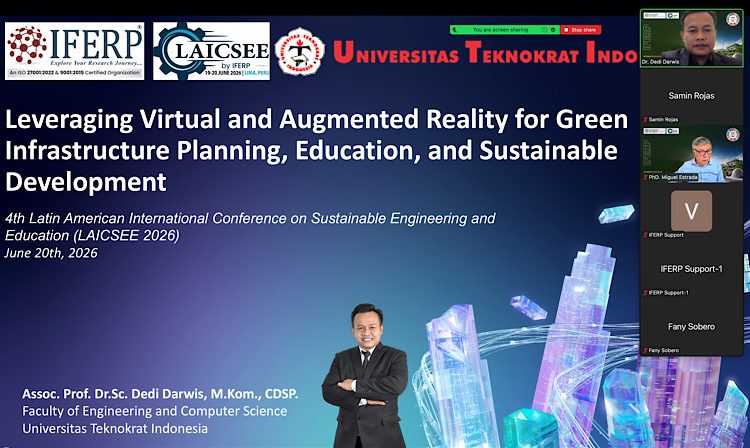
Bandar Lampung – Universitas Teknokrat Indonesia continues to strengthen its international presence through the achievements of its academic community. Assoc. Prof. Dr.Sc. Dedi Darwis, S.Kom., M.Kom., CDSP., Dean of the Faculty of Engineering and Computer Science (FTIK), was invited to serve as a Keynote Speaker at the prestigious 4th Latin American International Conference on Sustainable Engineering and Education (LAICSEE-2026), organized by the Institute for Engineering Research and Publication (IFERP) on June 19–20, 2026, in Lima, Peru. His participation in the international forum reflects the contribution of Universitas Teknokrat Indonesia academics to the fields of technology, education, and sustainable development through digital innovation. The hybrid conference brought together academics, researchers, and practitioners from various countries. Dedi Darwis delivered a presentation titled “Leveraging Virtual and Augmented Reality for Green Infrastructure Planning, Education, and Sustainable Development.” He shared the stage with keynote speakers from countries including Peru, Oman, Malaysia, Iran, and Bangladesh to discuss innovative approaches to global development challenges in the digital transformation era. Highlighting the Importance of Green Infrastructure During his presentation, Dedi Darwis highlighted the growing challenges associated with rapid urbanization. Urban areas currently account for more than 70 percent of global energy consumption and over 60 percent of greenhouse gas emissions, while the proportion of the global population living in cities is projected to approach 70 percent by 2050. He emphasized that green infrastructure—including urban forests, bioswales, ecological corridors, and green roofs—is increasingly important in addressing the impacts of climate change. “Virtual Reality (VR) and Augmented Reality (AR) can serve as a bridge to accelerate the planning, simulation, and educational processes related to green infrastructure, with greater cost efficiency and lower risks before physical implementation,” Dedi Darwis explained. Introducing Four Pillars of Immersive Technology Dedi Darwis also introduced four major technologies that are being developed at Universitas Teknokrat Indonesia: Augmented Reality (AR), Virtual Reality (VR), Mixed Reality (MR), and the Metaverse. These technologies are developed using modern platforms, including Roblox Studio and Meta Quest 2 and Meta Quest 3, to create more realistic, interactive, and collaborative learning and simulation experiences. According to Dedi Darwis, immersive technology is no longer limited to entertainment. It has increasingly become a strategic tool for education, research, urban planning, environmental conservation, and the development of future industries. Six Applications of VR and AR for Sustainable Development During the conference, Dedi Darwis presented six practical applications of VR and AR in supporting sustainable development: He also highlighted the potential of immersive technology to improve learning effectiveness. According to research referenced in his presentation, VR-based learning can increase knowledge retention by up to 75 percent compared with conventional learning methods. JUARAMETA: Indonesia’s Metaverse Innovation One of the highlights of the presentation was JUARAMETA (Center of Excellence in Metaverse) at Universitas Teknokrat Indonesia. JUARAMETA is a metaverse center focused on developing virtual-world technologies for education, culture, business, and society. It is presented as one of Indonesia’s pioneering initiatives in the field. At the international forum, Dedi Darwis introduced several innovations developed through JUARAMETA, including: These innovations demonstrate how metaverse technology can be applied to expand access to education, preserve cultural heritage, develop the digital economy, and support more inclusive community development. Opening Opportunities for International Collaboration At the conclusion of his presentation, Dedi Darwis invited academics and researchers from Latin America and other countries to explore opportunities for international research collaboration in immersive technology and sustainable development. “Sustainable development challenges are global challenges. Therefore, the solutions we develop must also be collaborative and cross-border. We are open to research partnerships, innovation, and joint technology development with institutions around the world,” he said. Rector Applauds Global Achievement Dr. H.M. Nasrullah Yusuf, S.E., M.B.A., Rector of Universitas Teknokrat Indonesia, expressed his appreciation and pride in Dedi Darwis’ achievement. He stated that the recognition received by Universitas Teknokrat Indonesia academics at international forums demonstrates the university’s growing contribution to global discussions on technology, education, and sustainable development. “We are very proud of Dr. Dedi Darwis’ achievement. His participation as a keynote speaker at a prestigious international conference in Peru demonstrates that Universitas Teknokrat Indonesia can contribute to global conversations about the future of technology, education, and sustainable development. This is a source of pride for the entire academic community,” said Nasrullah Yusuf. He added that the university will continue strengthening its research culture, innovation, and international collaboration to produce work with broader societal impact. Vice Rector Encourages Greater Global Engagement Dr. H. Mahathir Muhammad, S.E., M.M., Vice Rector of Universitas Teknokrat Indonesia, also expressed his appreciation for Dedi Darwis’ international contribution. According to him, the achievement reflects the continued efforts of Teknokrat academics to produce research that addresses contemporary global challenges. “We warmly welcome and take great pride in Dr. Dedi Darwis’ achievement as a keynote speaker at an international conference in Peru. His participation not only represents Universitas Teknokrat Indonesia on the global stage, but also demonstrates Indonesia’s contribution to the development of technology for sustainable development. We hope this achievement will inspire even more Teknokrat lecturers to participate in international academic forums,” Mahathir said. Supporting the Sustainable Development Goals Universitas Teknokrat Indonesia’s participation in LAICSEE-2026 is closely connected to several Sustainable Development Goals (SDGs). The innovations presented by Dedi Darwis support SDG 4 – Quality Education through immersive learning using VR and metaverse technologies, helping enhance educational quality and promote more inclusive learning opportunities. The initiative also contributes to SDG 9 – Industry, Innovation and Infrastructure by applying digital technologies to support more efficient and sustainable infrastructure development. The use of VR and AR in urban planning and environmental conservation is also aligned with SDG 11 – Sustainable Cities and Communities and SDG 13 – Climate Action. Meanwhile, the international research collaboration promoted through the conference supports SDG 17 – Partnerships for the Goals. Dedi Darwis’ participation as an international keynote speaker further highlights Universitas Teknokrat Indonesia’s commitment to developing technology-based innovations that address global challenges while contributing to sustainable development.
Universitas Teknokrat Indonesia Pioneers AI Integration in School Education

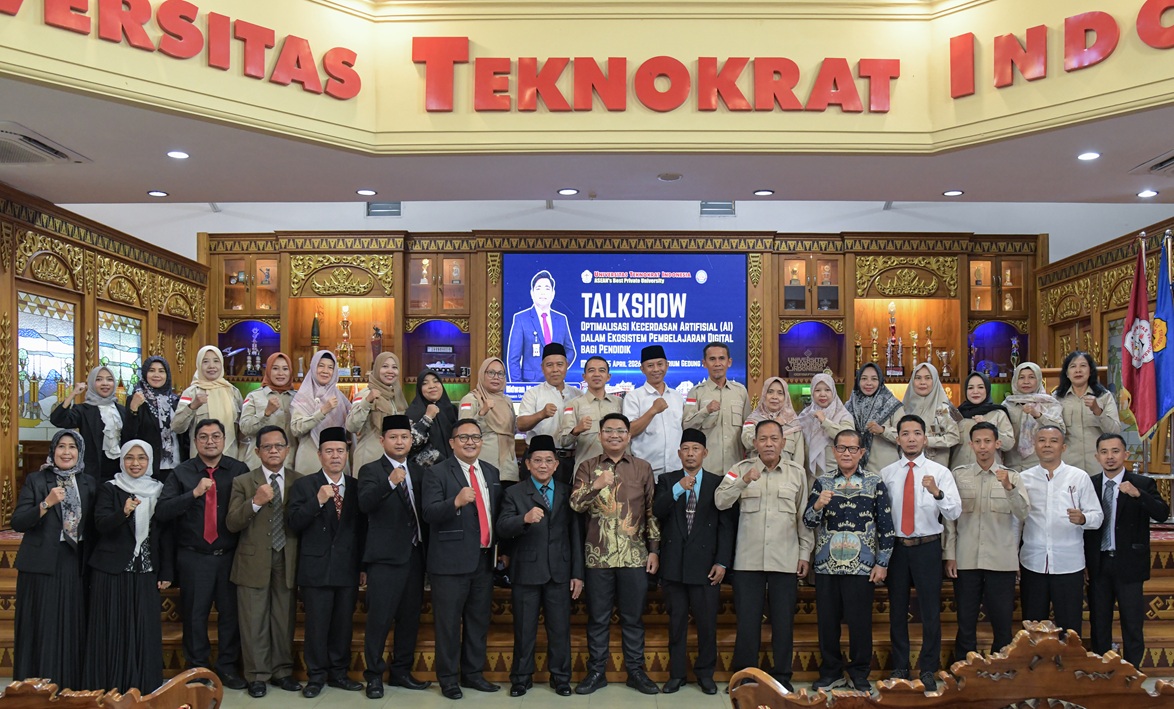
Bandar Lampung – Universitas Teknokrat Indonesia continues to strengthen its role in educational innovation by promoting the integration of Artificial Intelligence (AI) into school learning. This commitment was highlighted during a talk show titled “Optimizing Artificial Intelligence in the Digital Learning Ecosystem,” held at the Universitas Teknokrat Indonesia Auditorium on Wednesday, April 15, 2026. The event was organized as part of the Branch Conference of the Forum Komunikasi Kepala Sekolah Swasta (FKKS) of Bandar Lampung Vocational High Schools, bringing together school principals to discuss the opportunities and challenges of implementing AI in education. The session featured Ridwan Mahenra, S.Kom., M.Cs. (AI), a lecturer at Universitas Teknokrat Indonesia and an Artificial Intelligence specialist. He highlighted the potential of AI to support the learning process in the digital era, emphasizing that AI should not replace teachers but instead serve as a tool to improve the efficiency and quality of education. AI as a Solution to Educational Challenges During his presentation, Ridwan discussed one of the major challenges faced by educators: limited time due to heavy administrative responsibilities. These demands can reduce the time and attention teachers are able to devote to classroom learning. “AI is a collaborative solution. It works like a personal assistant that can read, summarize, and even write within seconds,” said Ridwan. He also pointed out the growing gap between rapid technological development and conventional teaching methods. As students become increasingly familiar with digital technology, educators need to adapt their approaches to ensure that learning remains relevant to the changing digital environment. AI-Powered Learning Innovations One of the innovations introduced during the session was Google NotebookLM, which can transform learning materials, such as textbooks, into podcast-style audio content. This approach can support auditory learners while providing students with a more engaging way to interact with educational materials. Ridwan also demonstrated how AI can assist teachers in preparing presentation materials. From summarizing teaching resources to creating slide outlines, AI can help reduce the time required to prepare classroom materials and allow teachers to focus more on the learning experience itself. Promoting Accurate and Responsible AI Use The workshop also addressed some of the limitations of AI, including the possibility of generating inaccurate information, commonly referred to as AI hallucinations. As a potential solution, participants were introduced to AI systems that can be configured to rely only on selected reference materials, such as textbooks and official documents uploaded by teachers. “AI can be configured to provide answers based only on verified sources and can even include page references, helping maintain the accuracy of educational content,” Ridwan explained. Participants were also introduced to effective prompt-writing techniques to produce more specific and practical AI outputs. These techniques can be applied to various educational tasks, including lesson-plan development and the preparation of assessment instruments. Encouraging Collaboration and School Implementation Suprihatin, S.Pd., Chair of the FKKS of Bandar Lampung Vocational High Schools, welcomed the initiative and highlighted its value in helping educators adapt to technological developments. “We hope that our collaboration with Universitas Teknokrat Indonesia can continue so that technologies such as AI can be implemented effectively in schools,” she said. A similar view was expressed by Sigit Haryadi, S.ST.Par., M.Par., Principal of SMK Kridawisata Bandar Lampung, who emphasized that understanding AI should begin with educational leaders before being introduced more broadly to students. He also expressed his commitment to following up on the program through further training for teachers and school principals. University Commitment to Educational Innovation The Rector of Universitas Teknokrat Indonesia, Dr. H.M. Nasrullah Yusuf, S.E., M.B.A., expressed his appreciation for the initiative and described it as part of the university’s efforts to promote innovation in education. “The use of AI in education is becoming increasingly important. This technology is not intended to replace teachers, but to strengthen their role so they can focus more on meaningful learning,” said the Rector. He emphasized that Universitas Teknokrat Indonesia will continue promoting the integration of technology into education to create a learning environment that is adaptive, innovative, and capable of competing in the global era. Supporting the Sustainable Development Goals (SDGs) The initiative reflects Universitas Teknokrat Indonesia’s commitment to supporting the Sustainable Development Goals (SDGs), particularly SDG 4 – Quality Education, through efforts to strengthen teachers’ competencies and promote technology-based learning innovations. The integration of AI into education also contributes to SDG 9 – Industry, Innovation, and Infrastructure by encouraging digital transformation in the education sector and preparing human resources with the skills needed to navigate an increasingly technology-driven global environment. Through initiatives such as this talk show, Universitas Teknokrat Indonesia continues to strengthen collaboration with schools while encouraging educators to explore the responsible and effective use of AI in education. The initiative represents an effort to prepare both teachers and students for a future in which digital technologies play an increasingly important role in learning and professional life.

Universitas Teknokrat Indonesia Lecturer Invited as Speaker at ICATIS 2026, Presenting AI Innovations for Sustainable Smart Industries

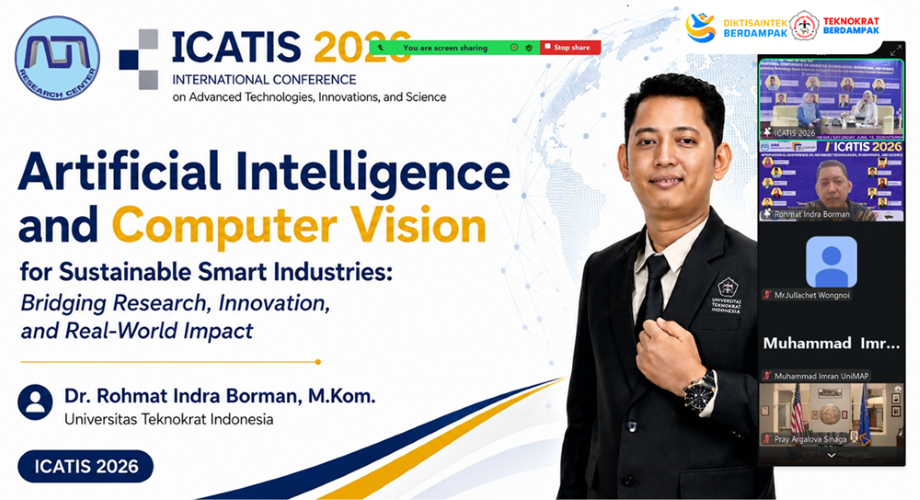
Bandar Lampung – Universitas Teknokrat Indonesia (UTI), recognized for its contributions to higher education in Lampung, has once again achieved international recognition through the accomplishments of Dr. Rohmat Indra Borman, M.Kom. He was invited to serve as a speaker at the International Conference on Advanced Technologies, Innovations, and Science (ICATIS) 2026, highlighting the university’s contributions to global research and technological innovation. Held in a hybrid format on Saturday, June 13, 2026, the international conference brought together academics, researchers, technology professionals, and experts from various countries. The event provided a platform for participants to exchange research findings, innovative ideas, and the latest developments in science and technology. Presenting AI and Computer Vision for Sustainable Smart Industries During the conference, Dr. Rohmat Indra Borman delivered a presentation titled “Artificial Intelligence and Computer Vision for Sustainable Smart Industries: Bridging Research, Innovation, and Real-World Impact.” His presentation explored recent research and technological developments focused on applying Artificial Intelligence (AI) and Computer Vision to support the advancement of sustainable smart industries. The topics covered several strategic areas, including Smart Agriculture, Intelligent Transportation Systems, Healthcare AI, and Artificial Intelligence of Things (AIoT). These technologies have the potential to improve efficiency, productivity, and sustainability across various sectors. Dr. Rohmat emphasized that technological development should go beyond automation and deliver tangible benefits to society while supporting sustainable development. “Research and technological innovation must address real-world challenges. Artificial Intelligence and Computer Vision have significant potential to help solve problems in agriculture, healthcare, transportation, and industry. Therefore, collaboration between academia, industry, and government is essential to accelerate the implementation of technology that creates positive impacts for society,” he stated during the conference. ICATIS 2026 featured keynote speakers, researchers, academics, and professionals from several countries, including Indonesia, Malaysia, Brunei Darussalam, and Thailand. Dr. Rohmat’s participation as an invited speaker highlights the international platform available for sharing research and innovation developed by Universitas Teknokrat Indonesia. Participation in international forums such as ICATIS also provides opportunities to expand academic networks, strengthen international research partnerships, and showcase the contributions of Indonesian higher education institutions to scientific and technological advancement. Vice Rector Applauds International Achievement Dr. H. Mahathir Muhammad, S.E., M.M., Vice Rector of Universitas Teknokrat Indonesia, expressed his appreciation and pride in Dr. Rohmat Indra Borman’s achievement. “We are very proud of the trust placed in Dr. Rohmat Indra Borman as an invited speaker at ICATIS 2026. His participation in this international forum demonstrates that the quality of research and innovation produced by Universitas Teknokrat Indonesia’s lecturers can compete and gain recognition at the global level,” said Mahathir. He explained that the achievement reflects the university’s commitment to developing a strong academic culture, promoting high-quality research, and expanding international collaboration. “We continue to encourage lecturers to actively conduct research, publish scientific work, and participate in international academic forums. Through these efforts, Universitas Teknokrat Indonesia can expand its contribution to scientific and technological development while creating meaningful benefits for society,” he added. Mahathir also highlighted the importance of lecturers’ participation in international academic forums as an inspiration for students to develop their skills, strengthen their research culture, and pursue opportunities on the global stage. The involvement of Universitas Teknokrat Indonesia’s lecturers in international conferences further demonstrates the institution’s engagement in technological development, innovation, and digital transformation in the modern era. Supporting the Sustainable Development Goals (SDGs) The research topics presented by Dr. Rohmat Indra Borman at ICATIS 2026 are closely connected to the Sustainable Development Goals (SDGs), particularly through the application of AI and smart technologies. SDG 2 (Zero Hunger) is supported through Smart Agriculture, which can help improve agricultural productivity and efficiency by utilizing intelligent technologies. Meanwhile, SDG 3 (Good Health and Well-Being) is relevant to Healthcare AI, which offers opportunities to improve healthcare services and support early detection systems through artificial intelligence. Research in Artificial Intelligence, Computer Vision, and AIoT also aligns with SDG 9 (Industry, Innovation, and Infrastructure) by promoting industrial transformation toward more efficient, modern, and sustainable systems. Furthermore, Intelligent Transportation Systems and smart city technologies contribute to SDG 11 (Sustainable Cities and Communities) by supporting the development of safer, more efficient, and environmentally friendly transportation systems. Through the active involvement of its lecturers in research and international academic forums, Universitas Teknokrat Indonesia continues to demonstrate its commitment to global development goals and technological innovation that benefits society. Strengthening Technological Innovation and Global Collaboration Dr. Rohmat Indra Borman’s participation in ICATIS 2026 reflects Universitas Teknokrat Indonesia’s efforts to strengthen its contribution to international research and innovation. The university’s commitment extends beyond teaching and education to include the development of research that addresses emerging challenges in society and industry. By promoting collaboration, scientific publication, and technological development, UTI continues to support the growth of academic excellence and innovation. This achievement highlights the importance of connecting research with real-world applications, while encouraging lecturers and students to contribute to the advancement of science and technology in Indonesia and around the world.

Scroll to top