
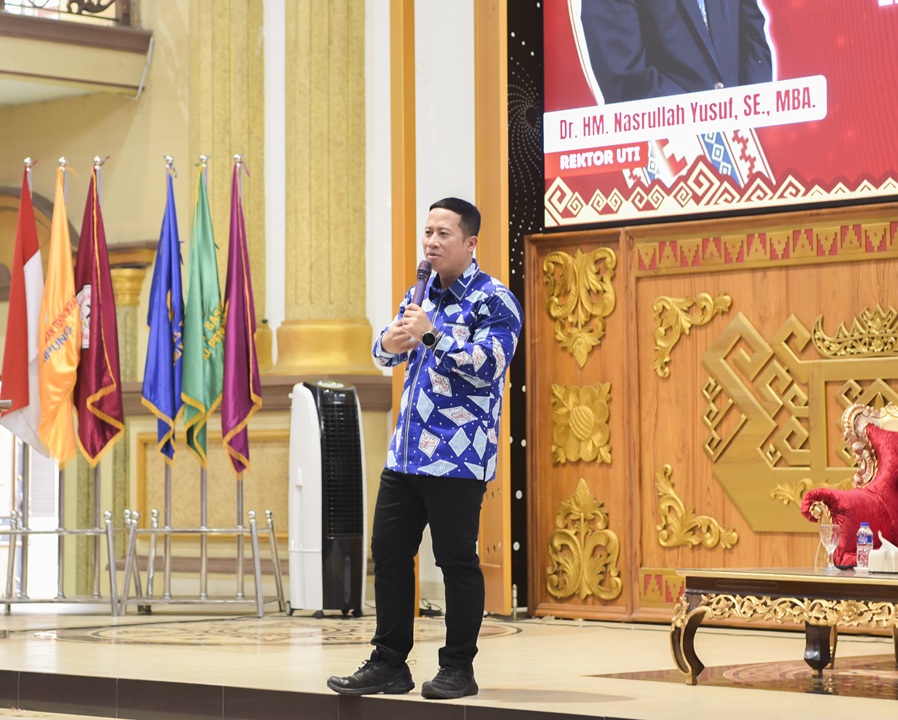
Bandar Lampung – True leadership is not determined by a title or formal position, but rather by a person’s ability to exercise self-control, set an example, inspire others, and bring about positive change. This message was conveyed by the Vice Rector of the University of Teknokrat Indonesia, Dr. H. Mahathir Muhammad, S.E., M.M., while serving as a guest speaker in the University of Teknokrat Indonesia’s 2026 Leadership Education Program (LEP) series on Friday, August 7, 2026.
During the orientation session attended by hundreds of students, Mahathir encouraged participants to understand leadership from its most fundamental foundation: self-leadership. According to him, a person cannot effectively lead others if they are not yet able to manage their own attitudes, actions, emotions, and personal responsibilities.
Leadership Is More Than Just a Title
Mahathir explained that a good leader is not merely an individual who holds a certain position or possesses specific authority. More than that, a leader must possess the personal capacity to exert a positive influence on their surroundings.
An ideal leader, he said, must be able to set an example, share a common vision, inspire others, empower team members, uphold honesty, possess competence, and have the courage to bring about change.
“A leader is not just someone who holds a title. A leader is someone who is able to set an example, share a common vision, inspire and empower others, and possess the integrity and competence to bring about change,” said Mahathir.
Leadership Starts with Yourself
In his presentation, Mahathir identified self-control as the cornerstone of building a leader’s character.
According to him, leadership must begin within oneself before one attempts to guide or lead a larger group. Self-control serves as the foundation for developing a responsible and consistent attitude, as well as the ability to handle various situations.
“Being a leader means having the courage to take control of oneself, taking responsibility for one’s actions, maintaining a positive attitude, having the courage to admit mistakes, learning from those mistakes, and giving recognition to others when they truly deserve it,” he said.
Mahathir believes that the courage to admit mistakes is not a sign of weakness in a leader. On the contrary, it is part of leadership maturity because it demonstrates a willingness to learn and improve.
Leaders Cannot Work Alone
In addition to personal abilities, Mahathir emphasized the importance of the ability to build relationships and collaborate within an organization.
According to him, no leader can achieve an organization’s goals alone. Every achievement requires the contribution of team members, each with their own competencies, roles, and responsibilities.
“The success of an organization relies heavily on group synergy. A leader must be able to build a team, harness the potential of each member, and create an environment that allows everyone to contribute,” he explained.
Building a Strong Team
Mahathir explained that a solid team requires several key elements. These include a shared goal understood by all members, a clear division of tasks and responsibilities, effective communication, sound decision-making mechanisms, and positive personal relationships.
These conditions will foster a healthy organizational environment while encouraging each member to contribute to the fullest extent possible.
In the context of student organizations, the ability to build a team becomes even more important because students will encounter a diverse range of personalities, perspectives, and backgrounds. Therefore, leadership must be built through communication, trust, empathy, and the ability to value each member’s contributions.
Tiered Leadership Toward Impact
Mahathir emphasized that the process of becoming a leader does not happen overnight. Leadership is a gradual process that begins with a commitment to oneself, then develops into the ability to influence and inspire others, and ultimately leads to building a team capable of achieving shared goals.
“Leadership isn’t just about leading others; it begins with the ability to lead oneself. Once we are able to lead ourselves, we learn to influence and inspire others, and then build a solid team to achieve common goals,” he concluded.
LEP 2026: Shaping Young Leaders of Character
The material presented by Mahathir was part of the Leadership Education Program 2026 (LEP 2026) organized by the Indonesian Technocrat University as an effort to build students’ leadership capacity.
The program is designed not only to improve managerial skills but also to foster character, integrity, communication skills, teamwork, decision-making, and the courage of students to become agents of change.
Universitas Teknokrat Indonesia believes that strengthening students’ leadership capacity is a crucial part of preparing the younger generation to face the dynamics of the workplace, society, and global challenges.
Aligned with the SDGs Agenda
The development of character and leadership competencies through LEP 2026 also supports the achievement of the Sustainable Development Goals (SDGs), particularly SDG 4: Quality Education. This program broadens the meaning of education by focusing not only on academic abilities but also on building skills, character, communication, leadership, and the ability to collaborate.
This initiative is also relevant to SDG 8: Decent Work and Economic Growth, as leadership, team-building skills, communication, and responsibility are essential competencies needed by the younger generation to enter the professional world and contribute productively.
Furthermore, fostering young leaders of integrity who can build effective organizations supports SDG 16: Peace, Justice, and Strong Institutions by reinforcing the values of accountability, transparency, integrity, and decision-making oriented toward the common good.
Through the 2026 Leadership Education Program, Universitas Teknokrat Indonesia continues to strengthen its commitment to nurturing a young generation that is not only academically excellent but also capable of leading themselves, inspiring others, fostering collaboration, and creating a positive impact on society and the nation.