Universitas Teknokrat Indonesia Pioneers AI Integration in School Education
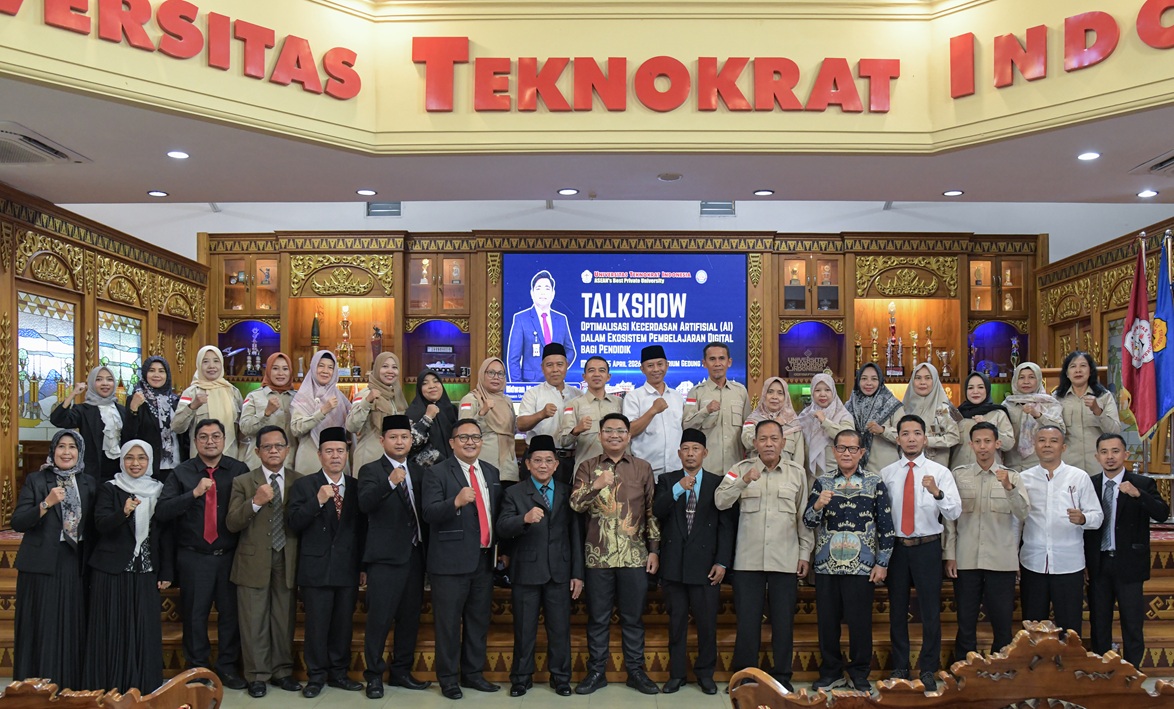
Bandar Lampung – Universitas Teknokrat Indonesia continues to strengthen its role in educational innovation by promoting the integration of Artificial Intelligence (AI) into school learning. This commitment was highlighted during a talk show titled “Optimizing Artificial Intelligence in the Digital Learning Ecosystem,” held at the Universitas Teknokrat Indonesia Auditorium on Wednesday, April 15, 2026. The event was organized as part of the Branch Conference of the Forum Komunikasi Kepala Sekolah Swasta (FKKS) of Bandar Lampung Vocational High Schools, bringing together school principals to discuss the opportunities and challenges of implementing AI in education. The session featured Ridwan Mahenra, S.Kom., M.Cs. (AI), a lecturer at Universitas Teknokrat Indonesia and an Artificial Intelligence specialist. He highlighted the potential of AI to support the learning process in the digital era, emphasizing that AI should not replace teachers but instead serve as a tool to improve the efficiency and quality of education. AI as a Solution to Educational Challenges During his presentation, Ridwan discussed one of the major challenges faced by educators: limited time due to heavy administrative responsibilities. These demands can reduce the time and attention teachers are able to devote to classroom learning. “AI is a collaborative solution. It works like a personal assistant that can read, summarize, and even write within seconds,” said Ridwan. He also pointed out the growing gap between rapid technological development and conventional teaching methods. As students become increasingly familiar with digital technology, educators need to adapt their approaches to ensure that learning remains relevant to the changing digital environment. AI-Powered Learning Innovations One of the innovations introduced during the session was Google NotebookLM, which can transform learning materials, such as textbooks, into podcast-style audio content. This approach can support auditory learners while providing students with a more engaging way to interact with educational materials. Ridwan also demonstrated how AI can assist teachers in preparing presentation materials. From summarizing teaching resources to creating slide outlines, AI can help reduce the time required to prepare classroom materials and allow teachers to focus more on the learning experience itself. Promoting Accurate and Responsible AI Use The workshop also addressed some of the limitations of AI, including the possibility of generating inaccurate information, commonly referred to as AI hallucinations. As a potential solution, participants were introduced to AI systems that can be configured to rely only on selected reference materials, such as textbooks and official documents uploaded by teachers. “AI can be configured to provide answers based only on verified sources and can even include page references, helping maintain the accuracy of educational content,” Ridwan explained. Participants were also introduced to effective prompt-writing techniques to produce more specific and practical AI outputs. These techniques can be applied to various educational tasks, including lesson-plan development and the preparation of assessment instruments. Encouraging Collaboration and School Implementation Suprihatin, S.Pd., Chair of the FKKS of Bandar Lampung Vocational High Schools, welcomed the initiative and highlighted its value in helping educators adapt to technological developments. “We hope that our collaboration with Universitas Teknokrat Indonesia can continue so that technologies such as AI can be implemented effectively in schools,” she said. A similar view was expressed by Sigit Haryadi, S.ST.Par., M.Par., Principal of SMK Kridawisata Bandar Lampung, who emphasized that understanding AI should begin with educational leaders before being introduced more broadly to students. He also expressed his commitment to following up on the program through further training for teachers and school principals. University Commitment to Educational Innovation The Rector of Universitas Teknokrat Indonesia, Dr. H.M. Nasrullah Yusuf, S.E., M.B.A., expressed his appreciation for the initiative and described it as part of the university’s efforts to promote innovation in education. “The use of AI in education is becoming increasingly important. This technology is not intended to replace teachers, but to strengthen their role so they can focus more on meaningful learning,” said the Rector. He emphasized that Universitas Teknokrat Indonesia will continue promoting the integration of technology into education to create a learning environment that is adaptive, innovative, and capable of competing in the global era. Supporting the Sustainable Development Goals (SDGs) The initiative reflects Universitas Teknokrat Indonesia’s commitment to supporting the Sustainable Development Goals (SDGs), particularly SDG 4 – Quality Education, through efforts to strengthen teachers’ competencies and promote technology-based learning innovations. The integration of AI into education also contributes to SDG 9 – Industry, Innovation, and Infrastructure by encouraging digital transformation in the education sector and preparing human resources with the skills needed to navigate an increasingly technology-driven global environment. Through initiatives such as this talk show, Universitas Teknokrat Indonesia continues to strengthen collaboration with schools while encouraging educators to explore the responsible and effective use of AI in education. The initiative represents an effort to prepare both teachers and students for a future in which digital technologies play an increasingly important role in learning and professional life.